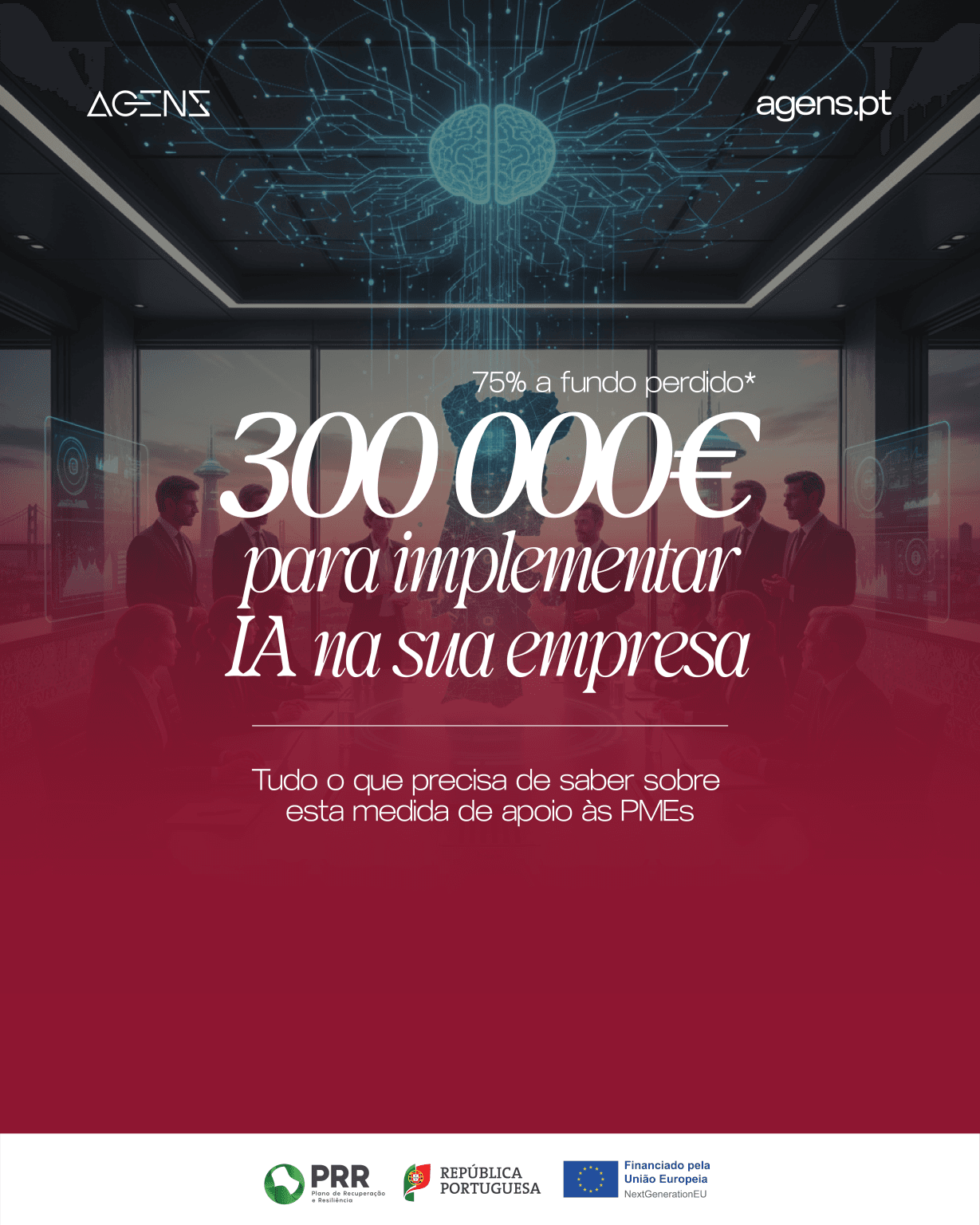
Portugal's Recovery and Resilience Plan (PRR) has launched the largest non-repayable funding programme for AI adoption in small and medium-sized enterprises. With 75% co-funding and up to €300,000 per company, the programme could transform the country's technology landscape (despite the tight deadlines)
Portugal has just opened one of the most generous funding opportunities ever for business digitalisation. The "AI in SMEs" programme (IA nas PME), part of investment C05-i14.01 of the Recovery and Resilience Plan, makes €100 million available in non-repayable grants to help micro, small and medium-sized enterprises adopt artificial intelligence solutions. The measure, managed by Banco Português de Fomento in partnership with the Recuperar Portugal Mission Structure (Estrutura de Missão Recuperar Portugal), comes at a critical moment: while artificial intelligence reshapes business models worldwide, many Portuguese companies still run on analogue or semi-digital processes, at risk of losing competitiveness in an increasingly automated market.
The programme stands out for its conceptual simplicity and broad scope. Any SME in mainland Portugal can apply, as long as it meets a few basic requirements: organised accounts, positive equity, no outstanding debts to the Tax Authority and Social Security, and electronic SME certification from IAPMEI. There are no sector restrictions. A bakery, an accounting firm, a mould factory or a retail shop can all access the funding. What matters is being able to show how artificial intelligence can solve concrete problems, increase efficiency or improve customer relationships.
The co-funding rate is 75% of eligible investment, capped at €300,000 per single undertaking. This means an SME can invest up to €400,000 in AI solutions and receive €300,000 in non-repayable support, contributing only €100,000 of its own. The minimum investment is €5,000, which makes the programme accessible even to micro-enterprises with more basic needs. And there is an extra advantage that is often overlooked: investments made since 1 January 2025 are eligible, which lets companies start implementing before their application is formally approved.
What can be funded and how to structure the investment
Eligible expenses are deliberately broad. The programme covers software purchases, including subscriptions to Software as a Service tools for up to 24 months. This includes platforms such as Microsoft 365 Copilot, Google Gemini, Claude or ChatGPT Enterprise, but also more specialised systems: predictive analytics software, process automation platforms, recommendation systems, conversational chatbots or computer vision tools. Equipment is also eligible: servers with processing capacity for AI, IoT sensors that feed predictive systems, cameras for image analysis, and the data infrastructure the solutions need to run.
One of the most interesting components is the option to fund people. Companies can hire up to two specialist technicians (AI platform managers, data scientists, programmers) on 24-month contracts, with a limit of €80,000 per post, adding up to €160,000 in hiring alone. This recognises that adopting AI isn't just a technology question: it takes in-house capacity to manage and operate the tools. Consultancy and training are also eligible, as long as they relate directly to implementing the project: process analysis, solution design, integration with existing systems, and training teams on the new tools. Finally, there is room for the cost of statutory auditors (ROC) or certified accountants who validate expenses in payment claims, up to a maximum of €2,500.
The programme splits AI solutions into two categories. The first covers productivity solutions: tools that make workers more efficient, such as virtual assistants for task management, automatic document analysis tools or predictive maintenance systems in industrial settings. The second category focuses on business applications, such as customer service chatbots, product recommendation systems, sales forecasting, sentiment analysis of feedback and inventory optimisation. The line between them isn't rigid; many projects combine both.
Practical examples of eligible projects
To get a better sense of the programme's reach, it's worth looking at concrete scenarios.
Imagine an accounting firm with 12 staff that spends weeks processing tax paperwork for dozens of clients at the end of every quarter. The firm decides to invest €35,000 in a combined solution: a subscription to an AI platform that automates document categorisation and tax data extraction (€12,000 over 24 months), integration of the platform with its existing accounting software through specialist consultancy (€8,000), Microsoft 365 Copilot licences for the whole team to draft reports and emails automatically (€9,000), two days of training so the team can master the tools (€3,500), and expense validation by a certified accountant (€2,500). Total investment: €35,000. PRR support: €26,250. Own contribution: €8,750. The firm expects to cut quarterly processing time by 40%, free up the team for higher-value advisory work and take on more clients without new hires.
Another example: a family-run garage with five employees facing two recurring problems. First, chaotic booking management: missed calls, unhappy customers, overlapping appointments. Second, difficulty predicting which parts it will need, leading to repair delays or excess stock. The garage invests €18,000 in an AI solution for smart booking with a chatbot built into WhatsApp and its website (€7,000), a stock forecasting system based on repair history (€6,000), consultancy for implementation and integration (€3,000), and team training (€2,000). Investment: €18,000. Support: €13,500. Own contribution: €4,500. Expected results: 60% fewer booking failures, 30% less idle stock, 20% more service capacity.
A third scenario: a small food distribution company with 15 staff and a fleet of six vehicles is facing rising costs from unplanned maintenance and inefficient routes. It decides to invest €85,000: a predictive maintenance system for the fleet based on data from IoT sensors installed in the vehicles (€28,000), an AI route optimisation platform that takes real-time traffic, delivery windows and customer priorities into account (€22,000), inventory management software with automatic demand forecasting (€15,000), tablets so drivers can access the system (€8,000), hiring a platform manager for 24 months (€60,000, but capped at €80,000 in funding, so only part of the cost counts), €9,000 of consultancy and €3,000 of validation. Total eligible: €85,000. Support: €63,750. Own investment: €21,250. The company expects to cut maintenance costs by 25%, make 15% more deliveries a day with the same fleet and reduce stock-outs by 35%.
Deadlines, process and criteria
The window of opportunity is narrow. Applications run in two phases: the first until 31 October 2025; the second only opens if the first phase doesn't use up the €100 million available. Given the expected demand and how generous the conditions are, it is all but certain the budget will run out in the first phase. Companies therefore have only a few days to put together technically sound applications. After submission through the SIGA-BF platform, the Recuperar Portugal Mission Structure assesses applications within a maximum of 40 working days, followed by a decision from Banco Português de Fomento within a further 10 days. The whole process, from submission to decision, takes around two to three months.
But not every application will be approved. That needs to be clear. The assessment system is based on merit criteria that score projects on a scale of 1 to 5, and a score of at least 3 is needed to be eligible. The assessment is split into two main criteria, each weighted at 50%.
The first looks at the quality and relevance of the project against the measure's objectives: essentially, whether the investment plan is coherent, well justified and aligned with the growth strategy presented. Generic projects, with vague descriptions or poorly justified investments, score low. Projects that clearly identify problems, propose suitable solutions and set realistic expectations of impact score high.
The second criterion assesses the project's contribution to the company's competitiveness, and has two components: net job creation and growth in gross value added (GVA). A micro-enterprise that creates no jobs but shows value-added growth above 10% can score well. A medium-sized company that creates three jobs and increases GVA by 15% has an excellent chance of approval. The challenge is quantifying these impacts credibly. Many applications fail precisely here: they present unrealistic projections or can't back up the expected gains with concrete data.
Payment method and execution
One often overlooked but crucial aspect is how payments work. Unlike many support programmes, this one provides an advance of 30% of the approved amount as soon as the acceptance agreement is signed, with no need to prove expenses. On an approved application of €75,000, the company immediately receives €22,500. It can then submit interim reimbursement claims as it makes investments, proving expenses with invoices validated by a statutory auditor (ROC) or certified accountant. The combined total of the advance and reimbursements cannot exceed 95% of the approved amount, with the remaining 5% kept for the final payment, which must be claimed within 30 working days of the project's completion.
Projects have up to 24 months to be carried out, counting from the investment start date, and can be extended by another six months in duly justified cases. This timeline is realistic: AI implementations take time for analysis, development, testing, adjustments and team training. Companies that underestimate how complex execution is may struggle to meet deadlines and prove results.
An opportunity that takes preparation
The programme's generosity is undeniable. For many SMEs, it is the only financially viable way to access technology that would otherwise be out of reach. But the opportunity comes with demands. Wanting to "do something with AI" isn't enough. You need to pinpoint exactly where artificial intelligence can create real value, choose solutions that suit the company's context, put together a credible implementation plan and back up expected returns with solid technical grounding. Improvised, generic applications without a clear strategy are unlikely to clear the assessment bar.
For companies that see the potential but don't know where to start, there are resources available. We have built a specialist assistant that can answer technical questions about the programme, such as eligibility, expenses, deadlines and assessment criteria. It is available 24 hours a day through this link.
For organisations looking for strategic support in structuring projects and applications, AGENS offers consultancy focused on the thoughtful implementation of artificial intelligence in business.
You can contact us at geral@agens.pt or 928142125.
The clock is ticking. This could be a once-in-a-generation chance to reposition the company in an increasingly technology-driven market. But only for those who act quickly, rigorously and with strategic vision.
Official documentation: Full notice – Ordinance (Portaria) No. 286/2025/1
Contacts for enquiries: EMRP: ific@recuperarportugal.gov.pt BPF: bpfomento@bpfomento.pt | Tel: 213 821 000